
The integration of generative artificial intelligence into the digital publishing ecosystem has fundamentally transformed how we create text, images, and video AI Content Ethics Guide 2026. However, with unprecedented capability comes an equally unprecedented level of responsibility. In 2026, the regulatory and algorithmic frameworks governing the internet have matured. Platforms are no longer simply marveling at AI; they are actively policing its misuse.
AI content ethics in 2026 focuses on transparency, accuracy, and compliance. Google rewards AI-assisted content that provides original value (EEAT), while YouTube mandates disclosure labels for synthetic media. Responsible creation requires human oversight to prevent misinformation and ensure alignment with evolving platform policies.
As a digital publisher, brand, or creator, your operational priority must shift from pure production volume to strict algorithmic and ethical compliance. Ignorance of platform policies is no longer a viable defense against domain de-indexing or channel deletion. Welcome to the definitive AI content ethics guide 2026. In this brief, we will establish the compliance protocols required to keep your content responsibly transparent, algorithmically favored, and entirely platform-compliant.
The Responsibility of the Creator: Why Transparency Matters
In the current media landscape, the line between organic and synthetic media has vanished entirely. Consumers can no longer rely on visual or textual anomalies to identify artificial content. Because the audience cannot independently verify the origin of digital media, the ethical burden of transparency falls entirely upon the creator.
Transparency is not merely a moral obligation; it is a vital business practice. Trust is the currency of the digital economy. If an audience discovers that a brand has been secretly passing off synthetic endorsements, AI-generated case studies, or automated opinion pieces as authentic human thought, the reputational damage is catastrophic and often irreversible. A compliant organization proactively discloses its AI use. By treating transparency as a feature rather than a liability, creators protect their brand equity and future-proof their domains against inevitable regulatory crackdowns.
Google’s Content Policies: ‘Helpful Content’ vs. ‘Spam’
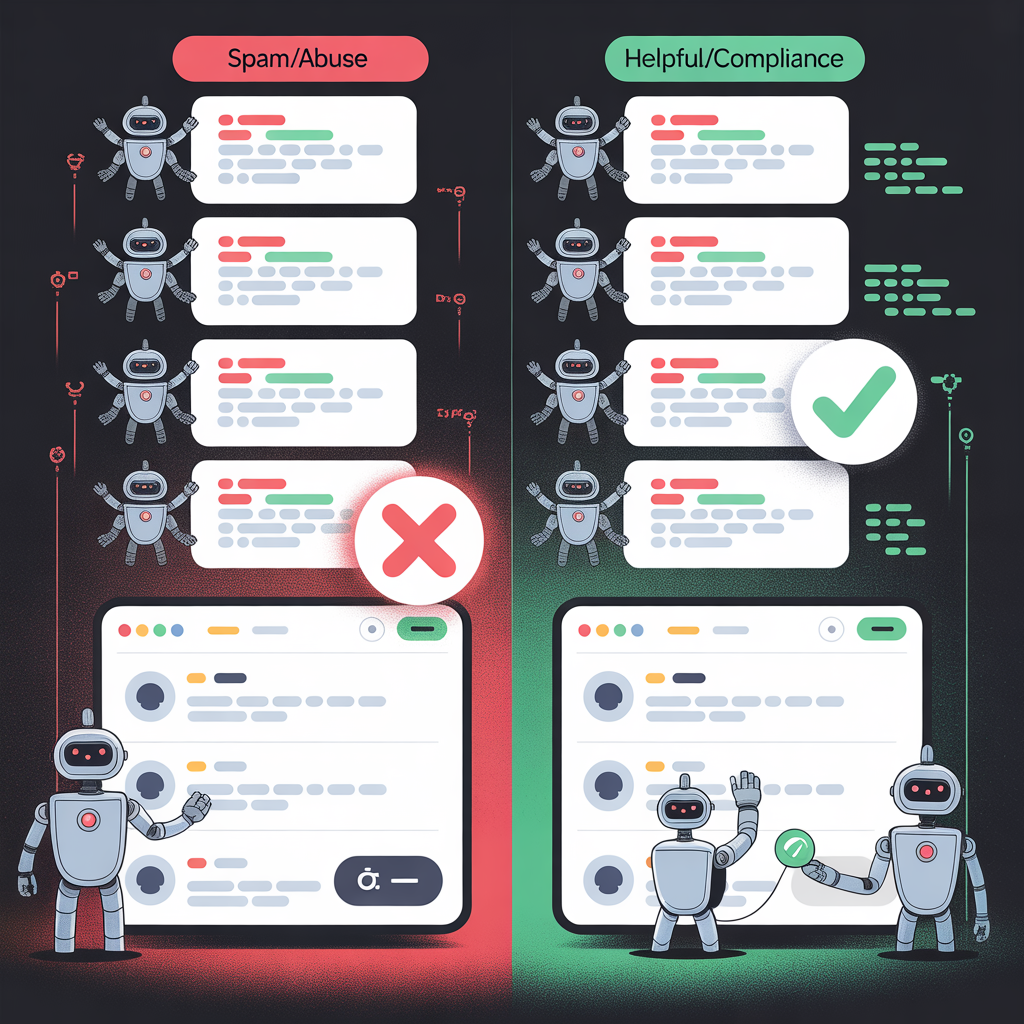
A primary concern for any digital operator is maintaining search visibility. There is a persistent, yet incorrect, assumption that Google penalizes all AI-generated text. This is categorically false. Google’s algorithms do not punish the use of AI; they punish the abuse of it.
As outlined in this AI content ethics guide 2026, Google’s systems—specifically the heavily updated Helpful Content framework—evaluate the utility of the text, not merely its origin. Google explicitly states that using automation to generate content with the primary purpose of manipulating search ranking is considered spam. If you use a Large Language Model to spin 10,000 low-effort articles on topics you have no experience in, your domain will be swiftly penalized or completely de-indexed.
Conversely, if you utilize AI as an editorial assistant—to outline, structure, or refine an article that contains your original insights, proprietary data, and verified expertise—you remain compliant. Google’s E-E-A-T (Experience, Expertise, Authoritativeness, Trustworthiness) paradigm dictates that the final output must provide a net-positive value to the user. Compliance requires ensuring that your AI-assisted content answers the user’s intent better, faster, and more accurately than the existing search results.
YouTube’s AI Disclosure Rules: Protecting Your Channel
Nowhere is the enforcement of AI ethics more stringent than on video platforms. The release of hyper-realistic generative video models like Google Veo and OpenAI Sora 2 has forced YouTube to implement severe operational protocols regarding synthetic media.
If you are generating assets using Sora 2, Veo, or similar high-fidelity models, you are subject to YouTube’s strict disclosure mandates. YouTube requires creators to explicitly label content that is visually realistic but fundamentally altered or synthetically generated. This is executed via the “Altered or synthetic content” toggle during the video upload process, which permanently affixes a disclosure label to the video player.
Failure to utilize this label is a direct violation of YouTube’s terms of service. If you attempt to pass off a Veo-generated street scene as a real news event, or a Sora 2-generated product demonstration as actual physical footage, the platform’s automated detection systems will flag your account. Penalties for non-compliance range from immediate algorithmic suppression (shadowbanning) to the complete demonetization of your channel, and in severe cases involving elections, public health, or financial markets, permanent account termination.
When using high-fidelity tools like Google Veo or OpenAI Sora 2, the mandatory disclosure labels mentioned in this guide are critical to avoid channel strikes.
Avoiding Misinformation: The Liability of the Publisher
Any robust AI content ethics guide 2026 must emphasize a critical technical limitation of all generative models: they hallucinate. They confidently invent statistics, fabricate historical events, and generate plausible but entirely fake citations.
When you publish a piece of content, you assume full liability for its accuracy, regardless of whether a human or an AI drafted it. In YMYL (Your Money or Your Life) categories—such as medical advice, financial guidance, or legal interpretation—publishing unverified AI hallucinations can lead to devastating real-world consequences and severe legal liability.
To remain compliant, organizations must institute mandatory fact-checking protocols. AI should never be allowed to publish directly to a live environment without human intervention. Every data point, quote, and statistic generated by an LLM must be cross-referenced against authoritative, primary sources before publication.
The Future of Human-AI Collaboration: The Indispensable Editor

The integration of AI does not eliminate the human workforce; it elevates the human from a drafter to a critical editor. A central tenet of our AI content ethics guide 2026 is that the human editor is the most important safeguard in your entire production pipeline.
We operate in a “Human-in-the-Loop” (HITL) paradigm. The AI is responsible for scale, ideation, and rapid drafting. The human is responsible for empathy, nuance, fact verification, and ethical alignment. An AI cannot understand the contextual sensitivity of a breaking news event, nor can it grasp the subtle tone requirements of your specific brand voice. The human editor ensures that the raw power of the AI is harnessed safely, legally, and compellingly. Investing in skilled AI editors—professionals who understand both prompt engineering and traditional editorial standards—is the most effective way to maintain compliance and quality.
Final Checklist: 5 Steps to Ethical Publishing
To operationalize these principles, we highly recommend bookmarking this AI content ethics guide 2026 and implementing the following 5-point checklist before publishing any AI-assisted media:
- The Disclosure Check: Is it explicitly clear to the end-user that this media (text, image, or video) was generated or significantly altered by AI? Have all required platform toggles (like YouTube’s synthetic label) been activated?
- The Verification Check: Has a human editor independently verified every fact, statistic, and citation generated by the model?
- The Value-Add Check: Does this content exist simply to manipulate search rankings, or does it offer unique, helpful, and net-new value to the reader?
- The Plagiarism and Copyright Check: Has the output been scanned to ensure it does not closely replicate copyrighted material, protected likenesses, or proprietary data?
- The YMYL Safety Check: If the content relates to health, finance, or safety, has it been reviewed by a certified subject matter expert to prevent harmful misinformation?
By strictly adhering to these protocols, you ensure that your organization not only survives the regulatory scrutiny of 2026 but thrives as a trusted, authoritative voice in the new digital era.